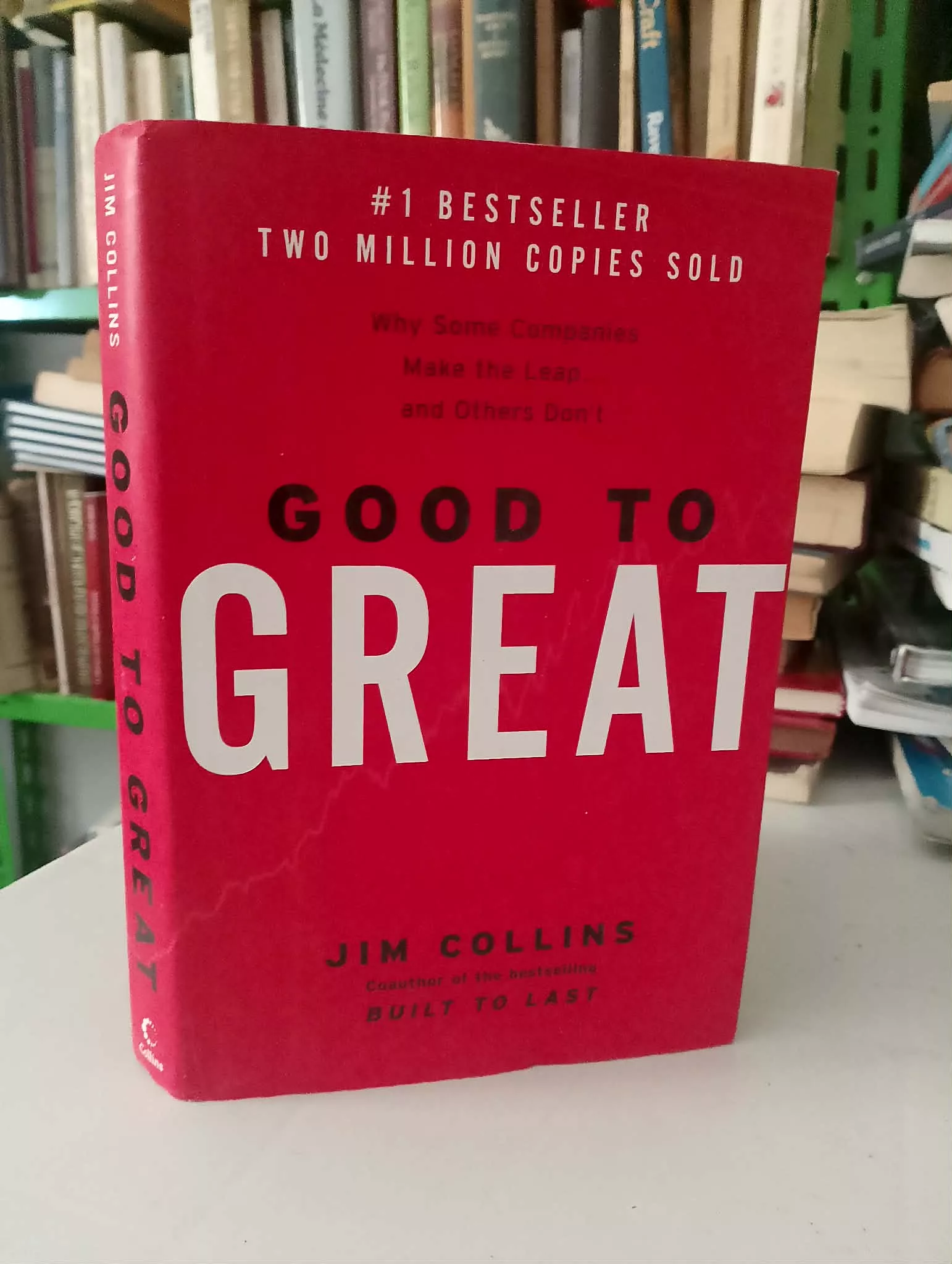
Good to great: why some companies make the leap... and others don't
de Collins James C. · Harper Business · 2001
60.00 TNDنسخة وحيدة
اطلب الآن
بشرائك هذا الكتاب مستعملًا، تتجنّبأثرنا
445 g من ثاني أكسيد الكربون
149 L من الماء
60 ورقة A4
1/197 من شجرة
محسوب لهذا الكتاب (499 g, 300 pages) بنفس طريقة عدّاد أثرنا، مع احتساب التوصيل.
الدفع عند الاستلام
نقدًا
نقدًا
التوصيل في 2 إلى 5 أيام
في كامل تونس
في كامل تونس
يبيعه

ملخّص
Good to great: why some companies make the leap… and others don’t de Jim Collins présente une étude de cinq ans sur les entreprises qui sont passées de la simple bonne performance à une réussite durable. Publié chez HarperBusiness, cet ouvrage de management est proposé en occasion sur Ktebi Ktebek.
État et détails de cet exemplaire
The Challenge
Built to Last, the defining management study of the nineties, showed how great companies triumph over time and how long-term sustained performance can be engineered into the DNA of an enterprise from the verybeginning.
But what about the company that is not born with great DNA? How can good companies, mediocre companies, even bad companies achieve enduring greatness?
The Study
For years, this question preyed on the mind of Jim Collins. Are there companies that defy gravity and convert long-term mediocrity or worse into long-term superiority? And if so, what are the universal distinguishing characteristics that cause a company to go from good to great?
The Standards
Using tough benchmarks, Collins and his research team identified a set of elite companies that made the leap to great results and sustained those results for at least fifteen years. How great? After the leap, the good-to-great companies generated cumulative stock returns that beat the general stock market by an average of seven times in fifteen years, better than twice the results delivered by a composite index of the world's greatest companies, including Coca-Cola, Intel, General Electric, and Merck.
The Comparisons
The research team contrasted the good-to-great companies with a carefully selected set of comparison companies that failed to make the leap from good to great. What was different? Why did one set of companies become truly great performers while the other set remained only good?
Over five years, the team analyzed the histories of all twenty-eight companies in the study. After sifting through mountains of data and thousands of pages of interviews, Collins and his crew discovered the key determinants of greatness -- why some companies make the leap and others don't.
The Findings
The findings of the Good to Great study will surprise many readers and shed light on virtually every area of management strategy and practice. The findings include:
- Level 5 Leaders: The research team was shocked to discover the type of leadership required to achieve greatness.
- The Hedgehog Concept (Simplicity within the Three Circles): To go from good to great requires transcending the curse of competence.
- A Culture of Discipline: When you combine a culture of discipline with an ethic of entrepreneurship, you get the magical alchemy of great results. Technology Accelerators: Good-to-great companies think differently about the role of technology.
- The Flywheel and the Doom Loop: Those who launch radical change programs and wrenching restructurings will almost certainly fail to make the leap.
“Some of the key concepts discerned in the study,” comments Jim Collins, "fly in the face of our modern business culture and will, quite frankly, upset some people.”
Perhaps, but who can afford to ignore these findings?
Résumé de Good to great: why some companies make the leap… and others don’t
Dans cet ouvrage, Jim Collins cherche à comprendre pourquoi certaines entreprises parviennent à passer du statut de bonne entreprise à celui de grande entreprise, alors que d'autres restent dans la médiocrité. Son équipe de recherche identifie un ensemble d'entreprises ayant réalisé ce bond et maintenu des résultats exceptionnels pendant au moins quinze ans, puis les compare à des entreprises comparables qui n'y sont jamais parvenues. L'analyse dégage des caractéristiques communes : un leadership de niveau 5 alliant humilité et détermination farouche, la règle du « qui » avant le « quoi », le concept du hérisson qui se concentre sur ce que l'organisation peut faire le mieux, une culture de la discipline, et l'effet volant d'inertie qui fait progresser l'entreprise pas à pas. Le livre s'appuie sur des critères de sélection rigoureux et des comparaisons détaillées.
À propos de Collins
Jim Collins est un chercheur et consultant américain en management, reconnu pour ses études sur les facteurs de performance durable des entreprises. Il est notamment l'auteur de Built to Last, écrit avec Jerry I. Porras, ainsi que de How the Mighty Fall et Great by Choice. Ancien professeur à la Stanford Graduate School of Business, il a fondé un laboratoire de recherche consacré à l'étude des organisations.
بطاقة الكتاب
- Titre : Good to great: why some companies make the leap… and others don’t
- Auteur : Collins
- Éditeur : Harper Business
- Catégorie : Management & leadership
- Langue : Anglais
Acheter Good to great: why some companies make the leap… and others don’t d'occasion en Tunisie
Vous cherchez Good to great: why some companies make the leap… and others don’t ? Cet exemplaire d'occasion est disponible sur Ktebi Ktebek, la première marketplace circulaire du livre de seconde main en Tunisie. Commandez-le en ligne et faites-vous livrer partout en Tunisie. Acheter d'occasion, c'est donner une seconde vie à un livre tout en lisant à petit prix. Découvrez d'autres livres dans la catégorie Management & leadership.
بطاقة الكتاب
- Date de parution
- 2001
- Nombre de pages
- 300
- État
- Comme neuf
- Format
- Relié
- Défaut
- Aucun défaut
- Poids
- 0.499 كيلوجرام
- Dimensions
- 23.5 × 15.5 × 2.7 سنتيميتر
- Éditeur
- Harper Business