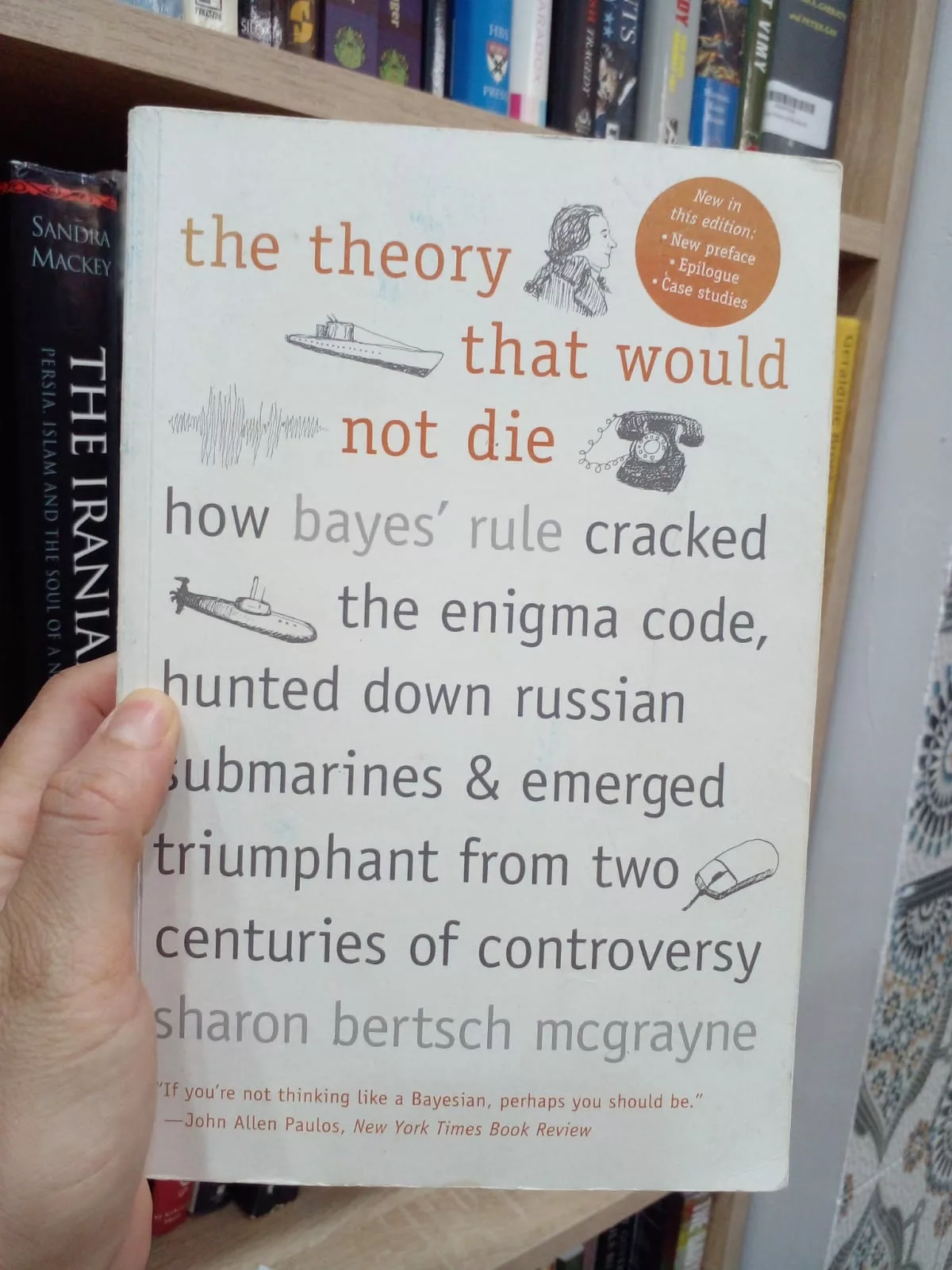
The Theory that Would Not Die How Bayes' Rule Cracked the Enigma Code, Hunted Down Russian Submarines, & Emerged Triumphant from Two Centuries of Controversy
from Sharon Bertsch McGrayne · Yale University Press · 2012
42.00 TNDOne-of-a-kind
Order Now
By buying this book, you avoid
≈ 318 g CO₂ emissions avoided
156 L water saved
62 saved A4 sheets
1/188 preserved tree
Calculated for this book (522 g, 336 pages) using our impact counter method, delivery included.
Cash on delivery
in cash
Delivered in 2 to 5 days
throughout Tunisia
Sold by


Niveau 5 sur 5Bibliothèque vivante
8 trophées sur 12 Premier livre
 Première vente
 Œil d’expert
 Série de 3
 Transparence totale
 Passeur de langues
- +2autres
Abstract
The Theory that Would Not Die How Bayes’ Rule Cracked the Enigma Code, Hunted Down Russian Submarines, & Emerged Triumphant from Two Centuries of Controversy est un ouvrage de Sharon Bertsch McGrayne consacré au théorème de Bayes. Publié par Yale University Press, il retrace l'histoire de cette règle, des origines au XVIIIe siècle à ses usages modernes.
État et détails de cet exemplaire
Bayes' rule appears to be a straightforward, one-line theorem: by updating our initial beliefs with objective new information, we get a new and improved belief. To its adherents, it is an elegant statement about learning from experience. To its opponents, it is subjectivity run amok.
In the first-ever account of Bayes' rule for general readers, Sharon Bertsch McGrayne explores this controversial theorem and the human obsessions surrounding it. She traces its discovery by an amateur mathematician in the 1740s through its development into roughly its modern form by French scientist Pierre Simon Laplace. She reveals why respected statisticians rendered it professionally taboo for 150 years--at the same time that practitioners relied on it to solve crises involving great uncertainty and scanty information (Alan Turing's role in breaking Germany's Enigma code during World War II), and explains how the advent of off-the-shelf computer technology in the 1980s proved to be a game-changer. Today, Bayes' rule is used everywhere from DNA de-coding to Homeland Security.
Drawing on primary source material and interviews with statisticians and other scientists, The Theory That Would Not Die is the riveting account of how a seemingly simple theorem ignited one of the greatest controversies of all time.
Résumé de The Theory that Would Not Die How Bayes’ Rule Cracked the Enigma Code, Hunted Down Russian Submarines, & Emerged Triumphant from Two Centuries of Controversy
Le théorème de Bayes semble être une règle simple d'une seule ligne : en mettant à jour nos croyances initiales à la lumière de nouvelles informations, on obtient une croyance nouvelle et améliorée. Pour ses partisans, c'est un énoncé élégant sur l'apprentissage par l'expérience ; pour ses opposants, c'est une subjectivité débridée. Sharon Bertsch McGrayne retrace sa découverte par un mathématicien amateur dans les années 1740, puis son développement, sous une forme proche de la version moderne, par Pierre-Simon Laplace. L'auteure explique pourquoi les statisticiens l'ont longtemps tenu à l'écart pendant environ 150 ans, tandis que des praticiens s'en servaient pour résoudre des problèmes d'incertitude extrême, notamment le décryptage d'Enigma par Alan Turing. Elle montre aussi comment l'informatique des années 1980 a changé la donne.
À propos de Sharon Bertsch McGrayne
Sharon Bertsch McGrayne est une auteure américaine de vulgarisation scientifique et journaliste. Elle est notamment connue pour ses livres Nobel Prize Women in Science (1993), consacré aux femmes lauréates du prix Nobel de sciences, et Prometheans in the Lab (2001), qui traite de l'histoire de la chimie et de son influence sur le monde moderne.
Tous les livres de Sharon Bertsch McGrayne
Fiche du livre
- Titre : The Theory that Would Not Die How Bayes’ Rule Cracked the Enigma Code, Hunted Down Russian Submarines, & Emerged Triumphant from Two Centuries of Controversy
- Auteur : Sharon Bertsch McGrayne
- Éditeur : Yale University Press
- Catégorie : Histoire des sciences
- Langue : Anglais
Acheter The Theory that Would Not Die How Bayes’ Rule Cracked the Enigma Code, Hunted Down Russian Submarines, & Emerged Triumphant from Two Centuries of Controversy d'occasion en Tunisie
Vous cherchez The Theory that Would Not Die How Bayes’ Rule Cracked the Enigma Code, Hunted Down Russian Submarines, & Emerged Triumphant from Two Centuries of Controversy ? Cet exemplaire d'occasion est disponible sur Ktebi Ktebek, la première marketplace circulaire du livre de seconde main en Tunisie. Commandez-le en ligne et faites-vous livrer partout en Tunisie. Acheter d'occasion, c'est donner une seconde vie à un livre tout en lisant à petit prix. Découvrez d'autres livres dans la catégorie Histoire des sciences.
Fiche du livre
- Date de parution
- 2012
- Language
- Anglais
- Nombre de pages
- 336
- State
- New
- Format
- Hardcover
- Weight
- 0.522 kg
- Dimensions
- 23.1 × 15.5 × 2.3 cm
- Publisher
- Yale University Press